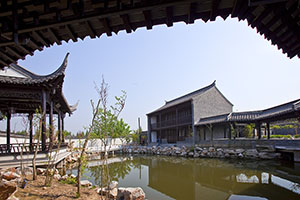
Wu Jutong Traditional Chinese Medicine Clinic
Wu Jutong Traditional Chinese Medicine Clinic. Covering an area of 3,390 square meters, the clinic was built to commemorate the 250th birthday of Wu Jutong. The government of Huai'an District has invested 12 million yuan in the comprehensive renovation and exhibition arrangement of the old building. In June 2008, the clinic was listed among the first education demonstration bases of traditional Chinese medicine culture in Jiangsu province by Traditional Chinese Medicine Bureau of Jiangsu Province.
Jiehua Hall. This couplet was a present that Wang Tingzhen, the emperor Daoguang's teacher and prime minister, gave to Wu Jutong. Wang Tingzhen spoke highly of Wu Jutong for his virtue and medical skill. Jiehua Hall is a clinic of the Wu family.
Wenxin Hall. It is the main building of the garden. Wu Jutong took benefiting the society and saving patients as his own duty all his life and believed that one should have a good conscience in conducting himself and practising medicine so he named the main building Wenxin Hall no matter where he lived. In front is a painting of Wu Jutong, a great medical scientist. Beside the painting hangs a couplet which was a gift from Gu Chun, member of the Imperial Academy, to Wu Jutong. Gu Chun spoke highly of Wu Jutong's medical skill. On roof beams are wooden carps which were very common at that time and implied the meaning of fortune and happiness. Wu Jutong once intended to take the imperial examinations. However, he decided to practise medicine after his father and nephew died of warm disease and fever. He left Huai'an and went to the capital to study when he was 19. When he was 23, he had the honor to go to Beijing to compile the medical part of the Siku Quanshu. When he was 47, he compiled the book Warm Disease Analysis. This book played a pivotal role during the SARS period in 2003. Although he didn't come from a family of traditional Chinese medicine, he was the first one who had prescriptions for the treatment of warm disease. He served three emperors Qianlong, Jiaqing and Daoguang as an imperial physician.
Huiying Hall. There was a saying at that time: one should study at a private school at daytime and read medical books at night so he could be a good doctor when he is poor and a good prime minister when he serves the royal court. Therefore, at that time, Hexia Ancient Town had more than 230 doctors who wrote more than 80 medical works. Hexia had already been rated as the Town of Doctors at that time. Huiying Hall is an exhibition hall of famous doctors and medical works through the ages.
Juhua Building. It is the highest building in the garden. Since Hexia features low terrain and is very hot and humid in summer, there was a saying that all gardens in Hexia could have no hills but must have a building.
Back Garden. It is more a medicinal herb garden than a back garden. All planted in the garden are Chinese herbal medicine. There are labels which explain their names and effects.